Japanese Escort Culture in Singapore

PART 1 – Japanese Escort Culture and Why It Feels Right at Home in Singapore
Japanese escort culture is something that is often talked about and rarely understood in Singapore.
Clients come to it with expectations informed by snippets of information gleaned from across the internet or comparisons drawn with other Asian cultures known for sexy getaways.
But Japanese escort culture is not about fantasy. It’s not about seduction or an emotional performance.
Japanese escort culture is defined by something much quieter—and ultimately, much more—
deliberate.
That something is restraint.
Restraint is not an emotional distance per se.
It’s not coldness for coldness’ sake.
It’s a social construct born of decades of people playing their assigned roles within systems that demand professionalism, self-control, and emotional cohesion.
Japan has an escort culture that developed within a system that sought to contain it rather than eliminate it.
That’s why it feels right at home in Singapore.
Singapore, like Japan, is a city of order.
Not a single person goes unscolded in public for not behaving correctly.
Professionals know how to conduct themselves.
People express emotions in public and at work as situational—not spontaneous—responses.
From a young age, everyone knows how to operate within relatively rigid systems successfully.
So, when Japanese escort culture comes to Singapore, it does not jar with the established rhythm.
It slips into the groove seamlessly.
Unlike the companion culture of escorts in countries where nightlife reigns supreme, Japanese companionship evolved alongside everyday life.
There’s no reliance on a quiet bar to get things going and a drunken stumble to end things.
There’s no need for emotional high drama or the overt sexualization of interactions.
Everything starts out quietly, progresses gently, and finishes off tidily.
But Japanese escort culture does not disappoint first-time clients; it surprises them.
Visitors to Singapore who are used to more overt escort cultures may feel put out at first.
There’s less verbal reassurance to be had.
There’s less exaggerated warmth.
There are fewer emotional cues.
But what takes the place of such things is something that many clients didn’t realize they needed until they got it.
Psychological ease.
Japanese escort culture does not require you to be someone you’re not.
You don’t have to entertain them.
You don’t have to explain yourself to them.
You don’t have to up the emotional ante or maintain a certain atmosphere.
You get to show up just as you are.
Which is an important thing for a certain type of client.
People who come to Singapore for business, pleasure, or extended stays are often those who spend most of their waking hours performing competence.
Executives, consultants, long-stay professionals, and expatriates who come here for work-and-play lives arrive in Singapore with full days and agendas that require self-control and long attention spans.
This containment isn’t constraining—it’s comforting.
In the Singaporean socio-cultural atmosphere where such things are predictable and not up in the air, this feels more respectful than ignoring. Boundaries become agreements rather than walls. Awkward silences are non-existent; silences are allowed. No one is clutching a bag of emotionally charged responses waiting for the wrong thing to be said.
“The next time I see you, I expect you to feel this way about me,” is not an unspoken rule in Japanese escort culture in Singapore for those who show up with no expectations.
In fact, it’s the opposite.
First-timers often say they feel pleasantly surprised that nothing is expected of them.
Emotionally, socially, psychologically.
It’s not a happy accident.
It’s intentional.
Japanese escort culture is designed not to clash with orderly cultures. It does not challenge status quos. It does not antagonize reality. It quietly requests to exist alongside it by offering companionship instead of competition.
And that’s how it is imperative to understand this first before delving into the psychological reasons why Japanese escort culture is a better fit for Singaporean long-stay visitors and high-responsibility travelers.
In Singapore, such restraint exists in various ways depending on the district in which one finds themselves. Business districts and areas frequented by long-stay visitors fall under the more discretion-driven and emotionally neutral expectations of escort culture as opposed to that of the nightlife
PART 2 – Business Travel, Long Stays, and the Quiet Weight of Emotional Fatigue
To fully understand why Japanese escort culture fits so naturally into Singapore, it is necessary to look beyond culture and into psychology—specifically, the psychological state of the people who come here. Singapore is not a city of accidental visitors. Most people arrive with purpose, responsibility, and timelines.
This is especially true for business travelers.
Business travel to Singapore is rarely relaxed. Meetings are precise, schedules are dense, and expectations are high. Many visitors operate under continuous evaluation—by colleagues, clients, partners, or institutions. Even moments of rest are often mentally occupied by preparation for what comes next.
Over time, this creates a distinct form of emotional fatigue.
Emotional fatigue is not the same as boredom or loneliness. It is the exhaustion that comes from constantly regulating oneself—maintaining composure, making decisions, and suppressing vulnerability. In cities where nightlife offers loud release, this fatigue is often masked with stimulation. In Singapore, such release rarely feels natural.
This is where Japanese escort culture becomes relevant.
Rather than offering stimulation, it offers relief from regulation. The interaction does not require emotional performance or narrative continuity. There is no expectation to be charming, witty, or enthusiastic. The client is not asked to lead the emotional tone of the evening.
This matters deeply to individuals who spend their days leading everything else.
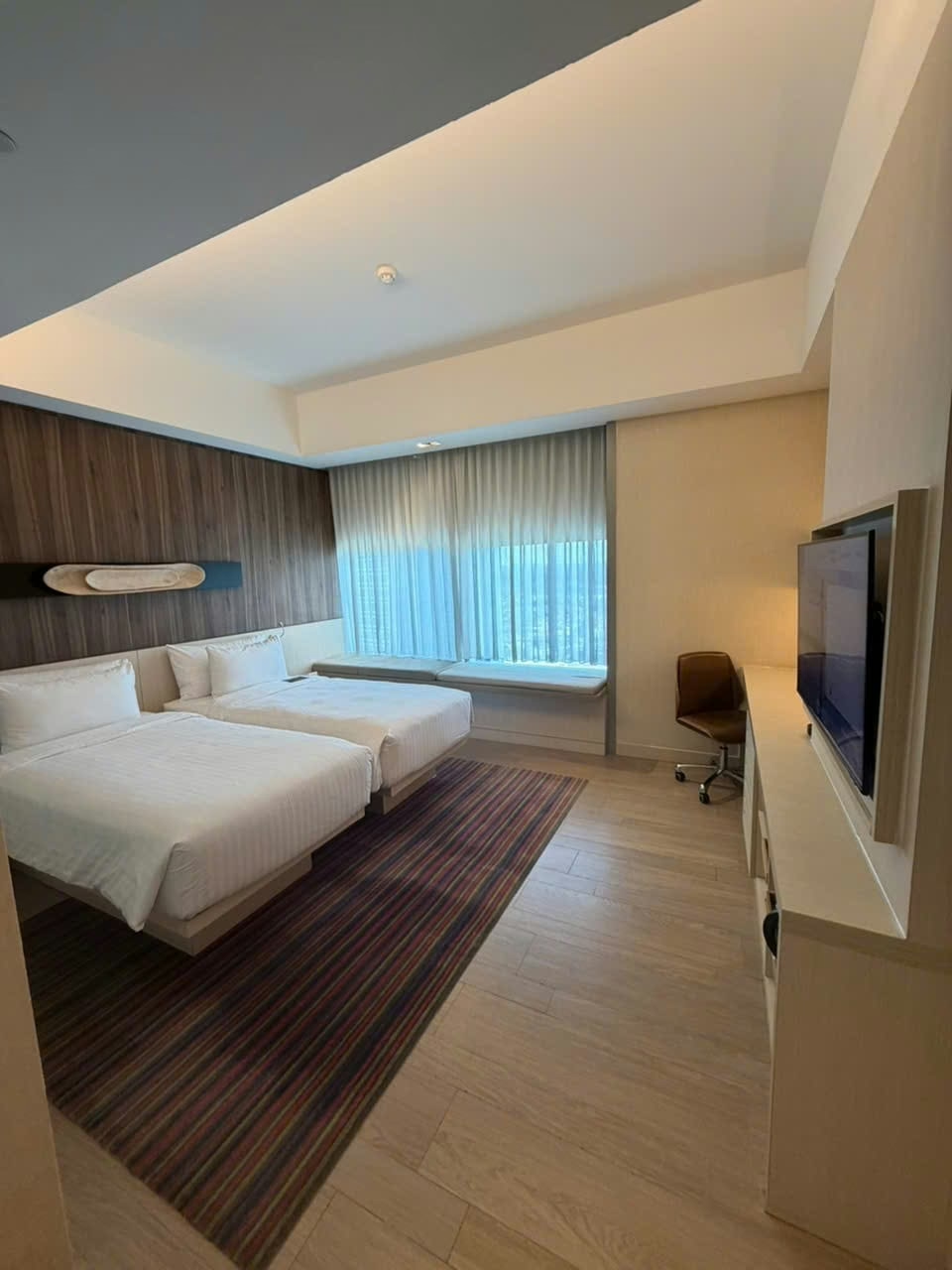
Many business travelers staying in areas such as Marina Bay or Orchard Road return to hotel rooms that are comfortable yet emotionally neutral. These rooms are designed for efficiency, not intimacy. Silence sets in quickly once the door closes.
Japanese escort companionship does not attempt to fill that silence with noise. It respects it.
Conversation unfolds slowly, if at all. Silence is not treated as something to fix. This permission to remain quiet—without awkwardness or expectation—allows the nervous system to downshift.
Long-stay visitors experience emotional fatigue differently, but no less intensely.
Individuals who relocate temporarily to Singapore for work, projects, or personal reasons often find themselves in a prolonged in-between state. They are not tourists, yet they are not locals. Their routines stabilize, but their emotional lives remain fragmented.
Over weeks or months, the absence of consistent human presence begins to register.
Unlike short-term travelers, long-stay visitors are not seeking novelty. They are seeking continuity. Yet forming meaningful social connections in a new city takes time—and often emotional energy they do not have.
Japanese escort culture offers a form of continuity without obligation.
The ability to see the same companion more than once—without emotional escalation—creates rhythm. Each interaction stands on its own, free from cumulative emotional weight. There is familiarity without attachment, presence without dependency.
This structure is particularly suited to Singapore, where stability is prized and excess is avoided.
Another group drawn to Japanese escort culture is those experiencing transitional stress—career shifts, relocations, recoveries, or personal recalibration. These individuals are often emotionally raw but unwilling to externalize that vulnerability.
Japanese escort companionship does not require vulnerability to be performed. It allows vulnerability to exist quietly, without commentary.
This distinction is subtle but profound.
In many escort cultures, intimacy is created through emotional mirroring—responding enthusiastically, validating continuously, escalating connection. While effective for some, this can feel overwhelming to individuals already managing emotional overload.
Japanese escort culture avoids this trap by maintaining emotional steadiness.
The escort does not attempt to steer the client’s emotional state. She does not amplify feelings or redirect them. She remains present, attentive, and consistent. This consistency becomes a psychological anchor.
In Singapore’s structured environment, where unpredictability is minimized in daily life, this emotional predictability feels safe.
Safety, in this context, is not physical—it is psychological.
Clients know what will happen, how it will unfold, and when it will end. There is comfort in this clarity. Emotional safety allows the body to relax, even if the mind has been tense for weeks.
It is also important to note that Japanese escort culture does not promise transformation. It does not suggest that companionship will fix loneliness, resolve stress, or replace meaningful relationships.
Instead, it offers a pause.
A pause from self-management. A pause from expectation. A pause from emotional labor.
In Singapore, where many visitors live highly optimized lives, this pause becomes valuable.
The emotional fatigue carried by business travelers and long-stay residents is rarely dramatic. It accumulates quietly. Japanese escort culture recognizes this accumulation and responds with restraint rather than intensity.
Understanding this psychological layer is essential before comparing Japanese escort culture with other regional models—and before deciding whether this approach aligns with one’s own emotional needs.
For many in Singapore, the answer is yes—not because the experience is exciting, but because it is sustainable.
Long-stay visitors often choose culturally diverse districts where evenings are quieter and more human-scaled. Bugis, in particular, reflects this balance between movement and calm.
You may also find this perspective explored further in: escort culture in Bugis.
To observe how companionship demand appears in open public listings, some readers also browse platforms like Locanto Singapore, where escort-related searches coexist with everyday personal ads, reflecting real urban behaviour rather than curated narratives.

PART 3 – Cultural Comparison, Who This Style Suits, and Why Singapore Is the Best Location
Once the structural and emotional elements of Japanese escort culture are in place, the final question is: how does this style compare to other escort cultures, and who does it suit, anyway?
There is no one-size-fits-all answer.
Japanese escort culture does not aim to suit everyone—and that is exactly what makes it effective.
In many Southeast Asian tourist areas, escort culture seems to operate along the lines of nightlife and immediacy. Interaction is emotive, impulsive, and engaging from the start. The warmth is there straight away. Validation is there all the time. It is a portal to a new reality, a way of escaping the old one.
For tourists looking for thrills, novelty or emotional punch, it does the job.
Japanese escort culture goes in the opposite direction.
It does not let the emotion out—it contains it. It does not allow for escapism—it offers stability. It does not usher the client into a new world; it allows them to stay in themselve.
If anything, this becomes even more apparent when you place Japanese escort culture in the context of other East Asian cultures.
Korean escort culture also seems to take a more sociable and playfully emotional approach to interaction. Conversation, teasing, jokes, and a more or less shared emotional vibe seem to be key. Chinese escort culture, again depending on context, seems to be more attentive and hospitable, offering emotional warmth through caring gestures and reassurance.
Japanese escort culture does neither overtly.
Its defining feature is emotional neutrality—not coldness, but balance. The escort does not attempt to elevate or redirect the client’s emotional state. She remains steady, allowing the client’s internal rhythm to settle naturally.
This makes the experience profoundly calming for certain individuals.
Singapore, as a city, reinforces this preference.
Singapore attracts people who function well under structure. Executives managing regional operations, professionals embedded in long-term projects, and expatriates navigating transitional periods all share a common trait: they are accustomed to control.
For these individuals, environments that demand emotional participation can feel intrusive rather than enjoyable.
Japanese escort culture respects autonomy.
The client is not asked to perform intimacy, explain themselves, or adopt a particular emotional role. The interaction unfolds quietly, with minimal friction. This is especially valuable in Singapore, where emotional expression is often contextual and private rather than public.
Who, then, benefits from this culture of escorts?
There are clients who appreciate Japanese escort culture in Singapore who value predictability over novelty.
They are comfortable with silence.
They respect boundaries.
They understand that presence need not be filled with interactive content.
They may be people who have come to excess during their lives and find it no longer satisfying at this point in time.
These clients aren’t looking for a way to avoid their responsibilities.
They’re looking for a way to lay them down for an evening.
For these types of clients, Japanese escort culture is not boring or limited, but instead reassuring, as all aspects will be known, when they’ll occur and for how long they’ll take up mental and physical space.
This is a psychologically safe space.
In a highly regulated society like Singapore, safety and predictability are respected as values. An escort culture that embraces them seems to make sense, not conflict.
Moreover, it’s worthwhile to note who does not benefit from it.
Those looking for teasing flirtation might find Japanese escort culture dull.
Those who want to be held close and fast to the heart of the matter might find something distanced in its restraint.
Those who expect to be told they’re beautiful over and over again may find their neediness perceived as a cultural divide.
These are not shortcomings of Japanese escort culture in Singapore, however.
These are its requirements.
Japanese escort culture in Singapore does not strive to be all things to all people but instead, the right thing to the right people.
And for those right people, long-term visitors and those with great responsibility find their cultural experience to be something like this:
The experience doesn’t cling.
It’s not complicated.
There’s no emotional edge to dull when the experience is done nor is there anything that requires trotting out the emotional baggage before work the next day.
The encounter fits in well with the next day’s routine.
This is how Japanese escort culture becomes sustainable.
In a city like Singapore where many visitors return again and again, it matters.
An experience that overwhelms can become a once-in-a-lifetime experience.
An experience that rejuvenates becomes a cyclical rhythm.
Japanese escort culture offers rhythm instead of overwhelm.
And that’s how it works.
That’s how, over time, the clients come to feel about their experiences.
What feels restrained eventually feels refined.
What feels distant eventually feels dependable.
What feels minimal eventually feels intentional.
That’s how it works when you think about living in Singapore.
Singapore doesn’t seek to impress with excess.
It seeks to find value in reliability, subtle comfort and no unnecessary friction.
Japanese escort culture understands this.
It doesn’t seek to contend with life but instead supplement it.
It’s gotten too hard and too overwhelming out there in the world for many people to even begin to know how they’re going to thrive within it.
Silently and elegantly without stimulation is how they can thrive with Japanese escort culture in Singapore instead of elsewhere.
It is not designed to change who you are. It is designed to let you rest as who you already are.
For readers who wish to explore how this restrained, emotionally balanced philosophy translates into real companion profiles, curated platforms such as SGBunny focus on clarity, discretion, and communication quality rather than volume-driven listings.
I am curious to find out what blog platform you are using? I’m experiencing some small security problems with my latest blog and I’d like to find something more risk-free. Do you have any solutions?